PhD Candidate @ Institute for Systems and Robotics (ISR)
Instituto Superior Técnico, Lisbon, Portugal
I am a PhD candidate at the Dynamical Systems and Ocean Robotics (DSOR) group in ISR/IST, under the supervision of Prof. Rita Cunha. My current research focuses on the intersection of vision-aided estimation, control and motion planning for target tracking.
I am also the developer of Pegasus Simulator and the Pegasus GNC projects. Previously, I worked as an R&D engineer at DSOR/ISR on the MEDUSA class of marine vehicles and the EU BlueRoSES project under the supervision of Prof. António Pascoal.
Languages
Robotics
Vision + ML + Optimization
Tools


Supervisor
Expected Delivery
January 2027
Associated Projects
Training & Summer Schools
Selected Publications

ISR Workshop: 2-hour session introducing ROS 2 to lab members. Organized following my Teaching Assistant role in the Autonomous Systems course, at the invitation of Prof. Rodrigo Ventura.

Second semester - 4 period. Concurrent with the start of the PhD.

Second semester. Concurrent with the development of the MSc thesis and research work at DSOR/ISR.

Teaching kids ages 15-17 the basics of computer architectures (from a simple NAND gate to a complete RAM circuit).


Three-month visiting scholar at AirLab under the CMU-Portugal program, affiliated with ISR-Lisbon throughout.

Research on nonlinear distributed cooperative control, path following (PF), and cooperative path following (CPF). Ran concurrently with the MSc thesis.
Theory: Nonlinear PF & CPF for AUVs and quadrotors in pre-defined formations; B-Spline and 2-D point cloud path-planning.
Implementation: PF/CPF algorithms in C++ (ROS1); B-Spline planner in Python; Gazebo 3D simulation tools for the MEDUSA AUVs.
Field & Integration: Adapted DSOR stack to BlueROV; prepared final demos for the OceanTech HROV and BlueRoSES EU projects.

Backend developer intern at Mercedes-Benz.io using Kotlin and Spring Framework.
Learned: Deploying micro-services in Kubernetes; connecting Kotlin backend to a Javascript frontend via REST and gRPC.
Stack: Kotlin, Spring, Docker, Kubernetes, PostgreSQL · Agile/Scrum.
Lead Author
Pegasus Simulator is a modular UAV simulation framework built on top of NVIDIA Isaac Sim. It supports PX4, ArduPilot and ROS 2 integration, multi-vehicle scenarios, and fully custom controller backends. Designed for both GUI and scripted standalone workflows. It was created in 2023 with the original purpose of serving my PhD workplan.
ROS 2 GNC framework for autonomous drones, built around PX4 - the backbone of PhD experimental validation.
Previous Lab Projects
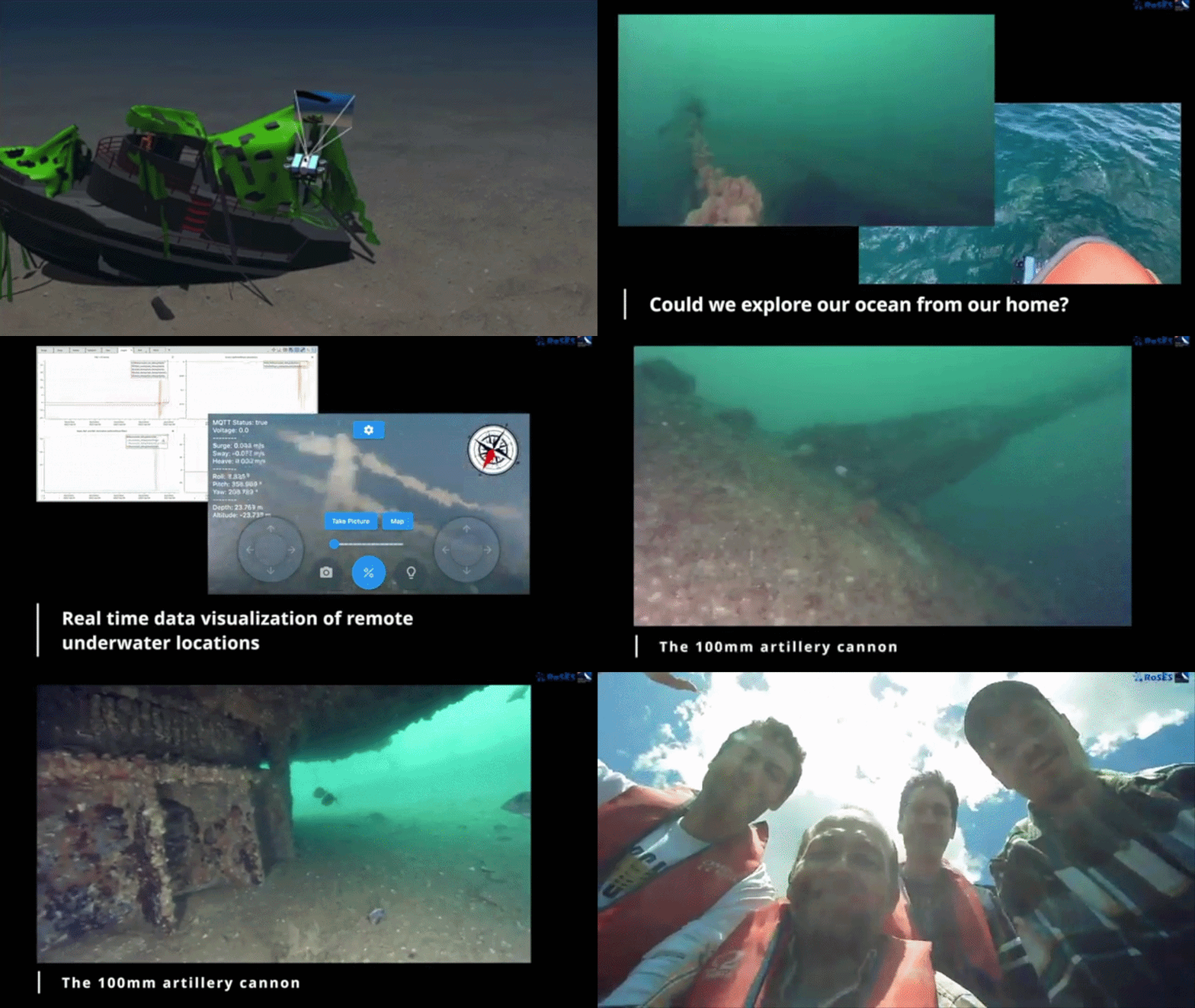
Developing remote underwater vehicle operation capabilities, integrating DSOR's MEDUSA codebase with ArduSub and enabling full remote operation from a custom-built mobile app.
Field trials, May 2-4, 2022
Marina de Portimão, Portugal
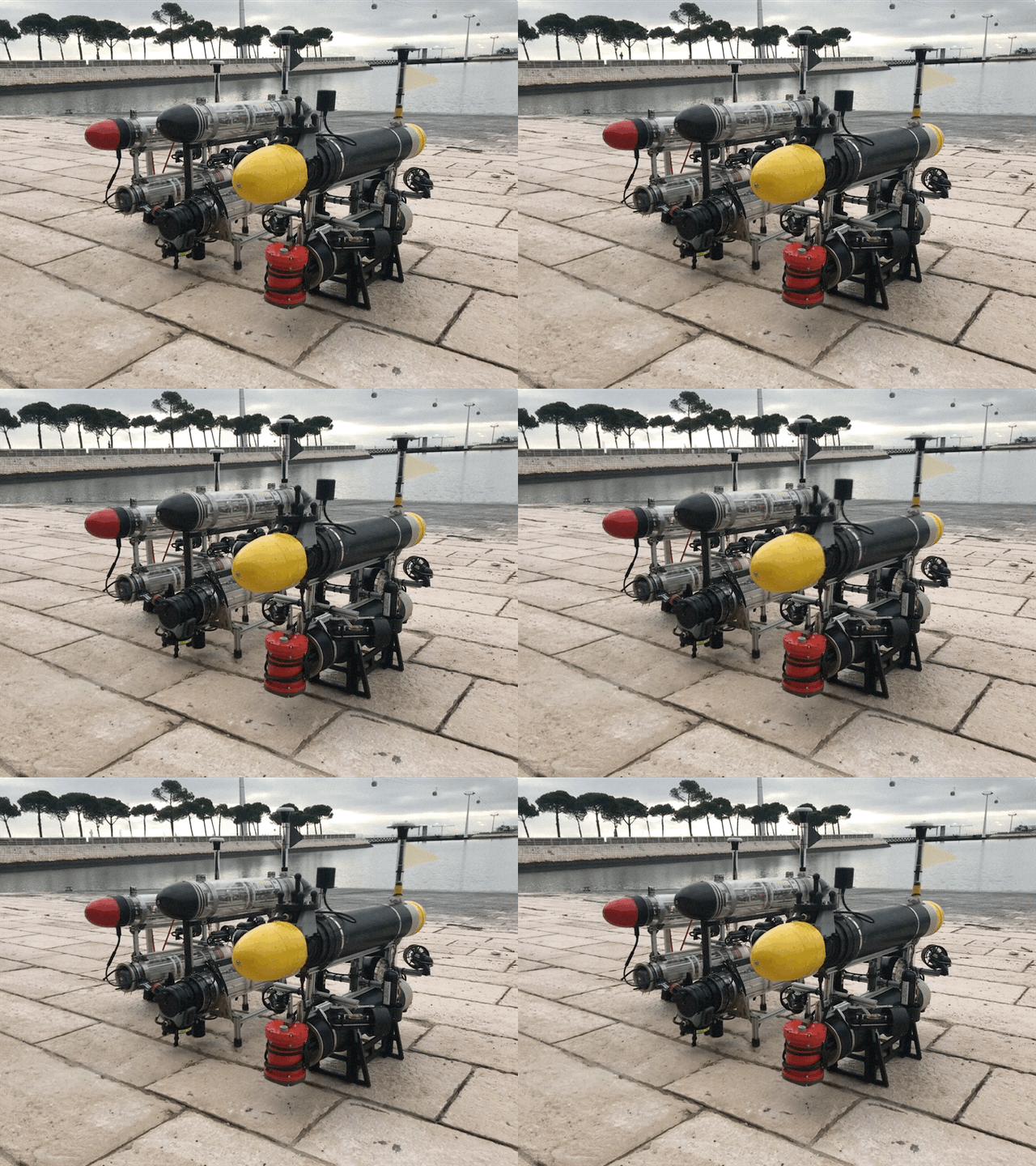
Multi-vehicle GNC stack for DSOR's marine robots. Contributed across the full stack from control algorithms to simulation and DevOps infrastructure.
Joined towards the end of the project, contributing to field trials and basic hardware and software setup. A great experience working with a multidisciplinary team in a real operational marine environment.
Field trials, April 28, 2022
Doca dos Olivais, Portugal
Abstract
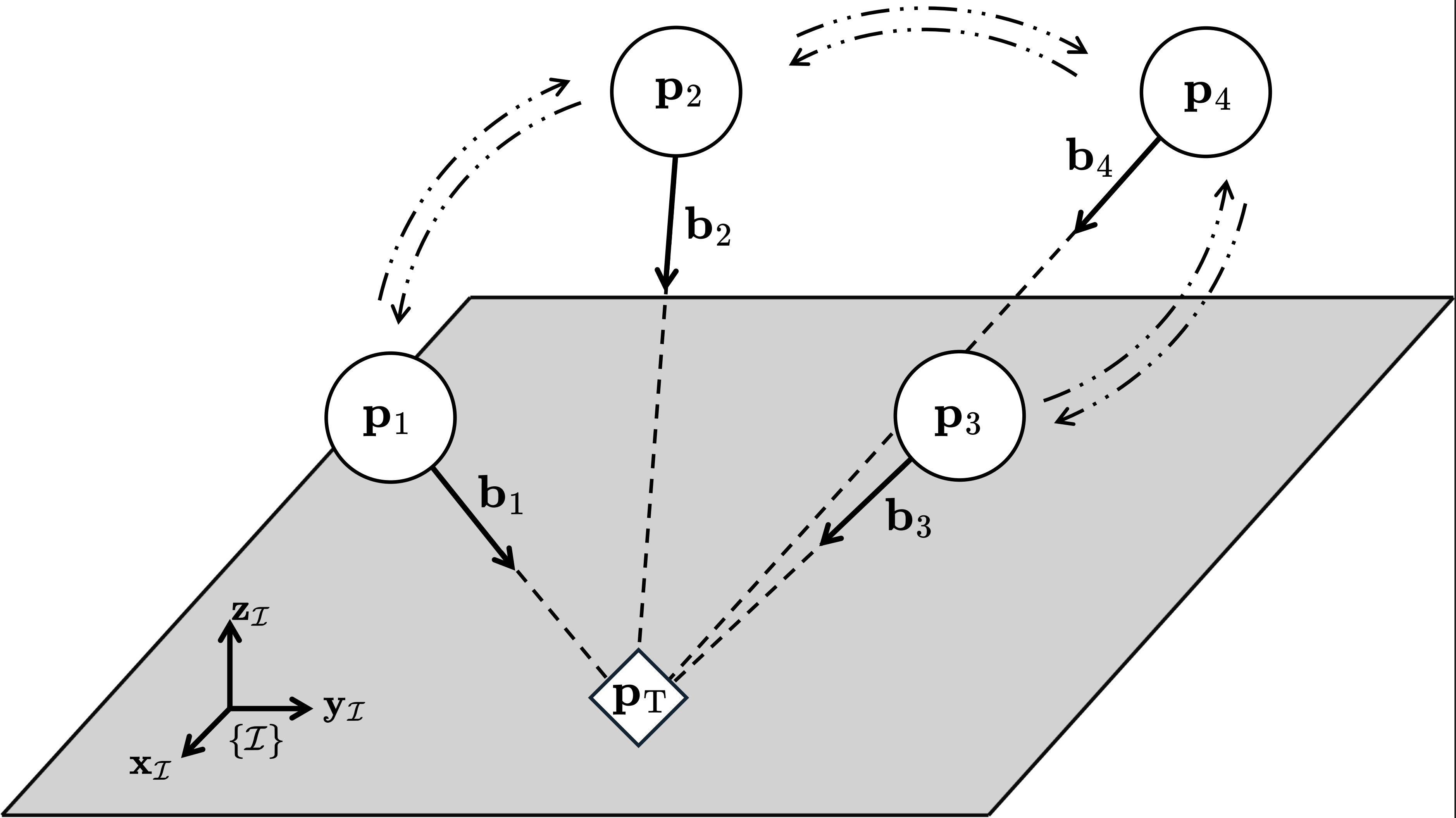
This paper introduces a novel distributed consensus-based observer design that enables a group of agents in an undirected communication network to solve the problem of target tracking, where the target is modeled as a chain of integrators of arbitrary order. Each agent is assumed to know its own position and simultaneously measure bearing vectors relative to the target. We start by introducing a general continuous time observer design tailored to systems whose state dynamics are modeled as chains of integrators and whose measurement model follows a particular nonlinear but observer-suited form. This design leverages a correction term that combines innovation and consensus components, allowing each agent to broadcast only a part of the state estimate to its neighbours, which effectively reduces the data flowing across the network. To provide uniform exponential stability guarantees, a novel result for a class of nonlinear closed-loop systems in a generalized observer form is introduced and subsequently used as the main tool to derive stability conditions on the observer gains. Then, by exploring the properties of orthogonal projection matrices, the proposed design is used to solve the distributed target tracking problem and provide explicit stability conditions that depend on the target-agents geometric formation. Practical examples are derived for a target modeled as first-, second-, and third-order integrator dynamics, highlighting the design procedure and the stability conditions imposed. Finally, numerical results showcase the properties of the proposed algorithm.
Abstract
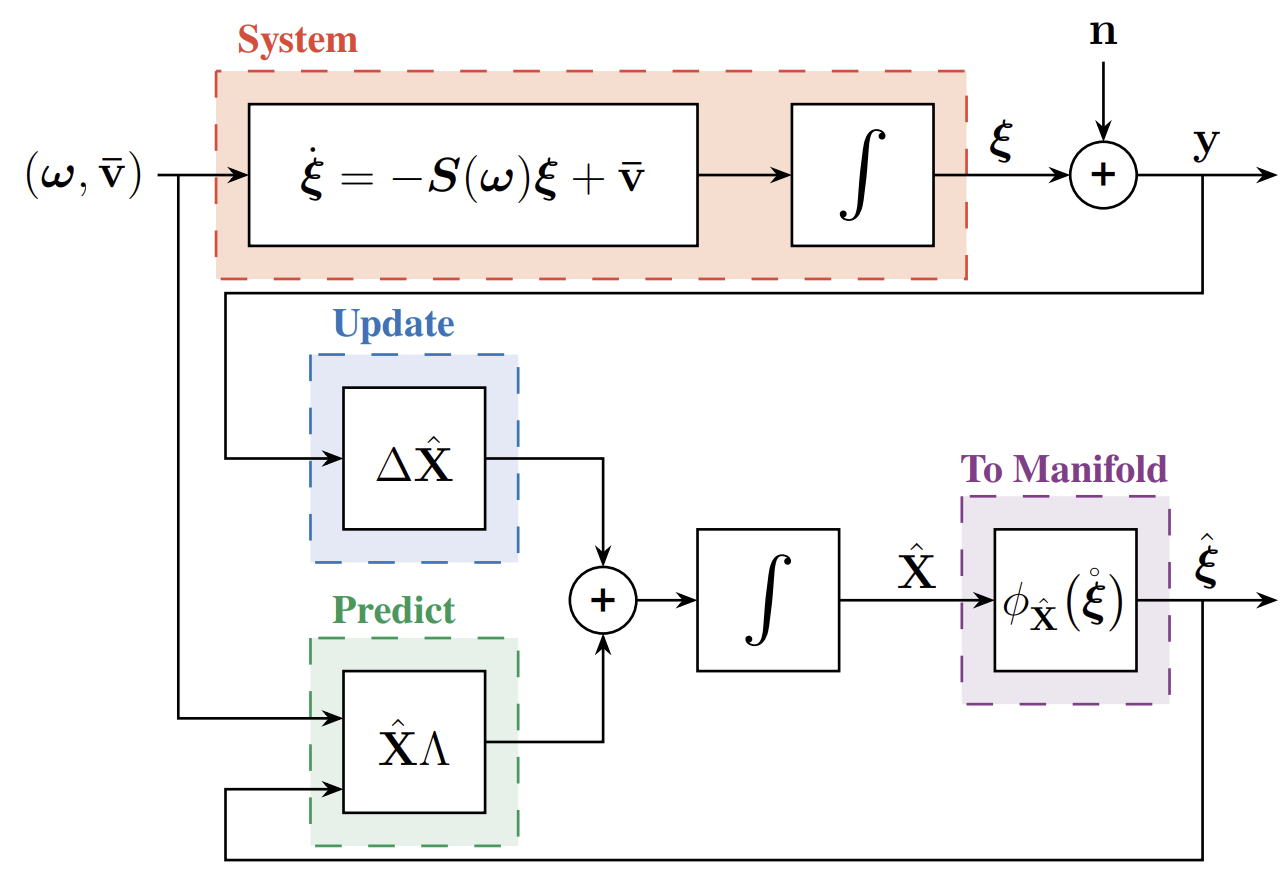
This work addresses the problem of designing an equivariant observer for a first order dynamical system on the unit-sphere. Building upon the established case of unit bearing vector dynamics with angular velocity inputs, we introduce an additional linear velocity input projected onto the unit-sphere tangent space. This extended formulation is particularly useful in image-based visual servoing scenarios where stable bearing estimates are required and the relative velocity between the vehicle and target features must be accounted for. Leveraging lifted kinematics to the Special Orthogonal group, we design an observer for the bearing vector and prove its almost global asymptotic stability. Additionally, we demonstrate how the equivariant observer can be expressed in the original state manifold. Numerical simulation results validate the effectiveness of the proposed algorithm.
Abstract
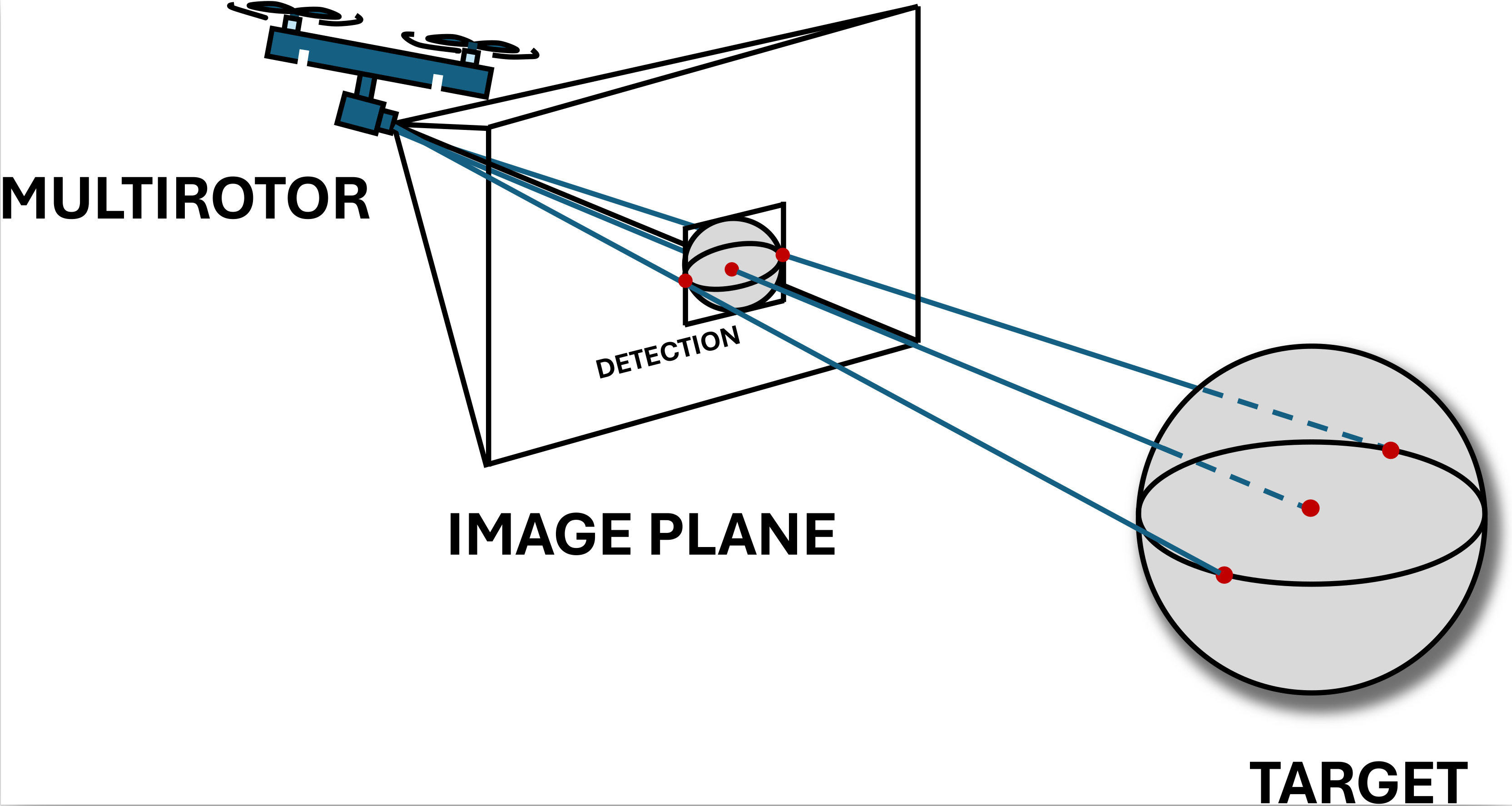
This work addresses the problem of designing a visual servo controller for a multirotor vehicle, with the end goal of tracking a moving spherical target with unknown radius. To address this problem, we first transform two bearing measurements provided by a camera sensor into a bearing-angle pair. We then use this information to derive the system’s dynamics in a new set of coordinates, where the angle measurement is used to quantify a relative distance to the target. Building on this system representation, we design an adaptive nonlinear control algorithm that takes advantage of the properties of the new system geometry and assumes that the target follows a constant acceleration model. Simulation results illustrate the performance of the proposed control algorithm.
Abstract
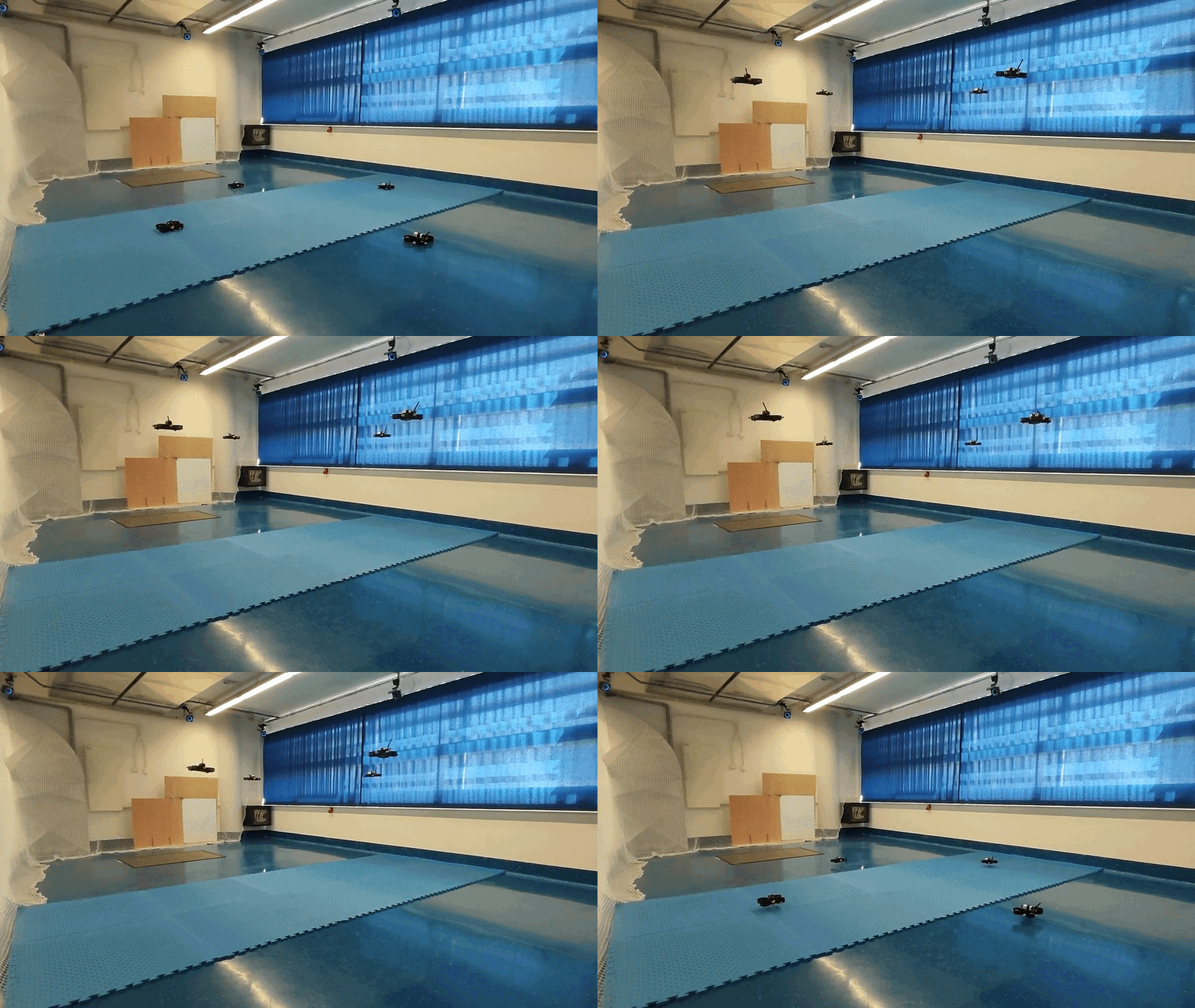
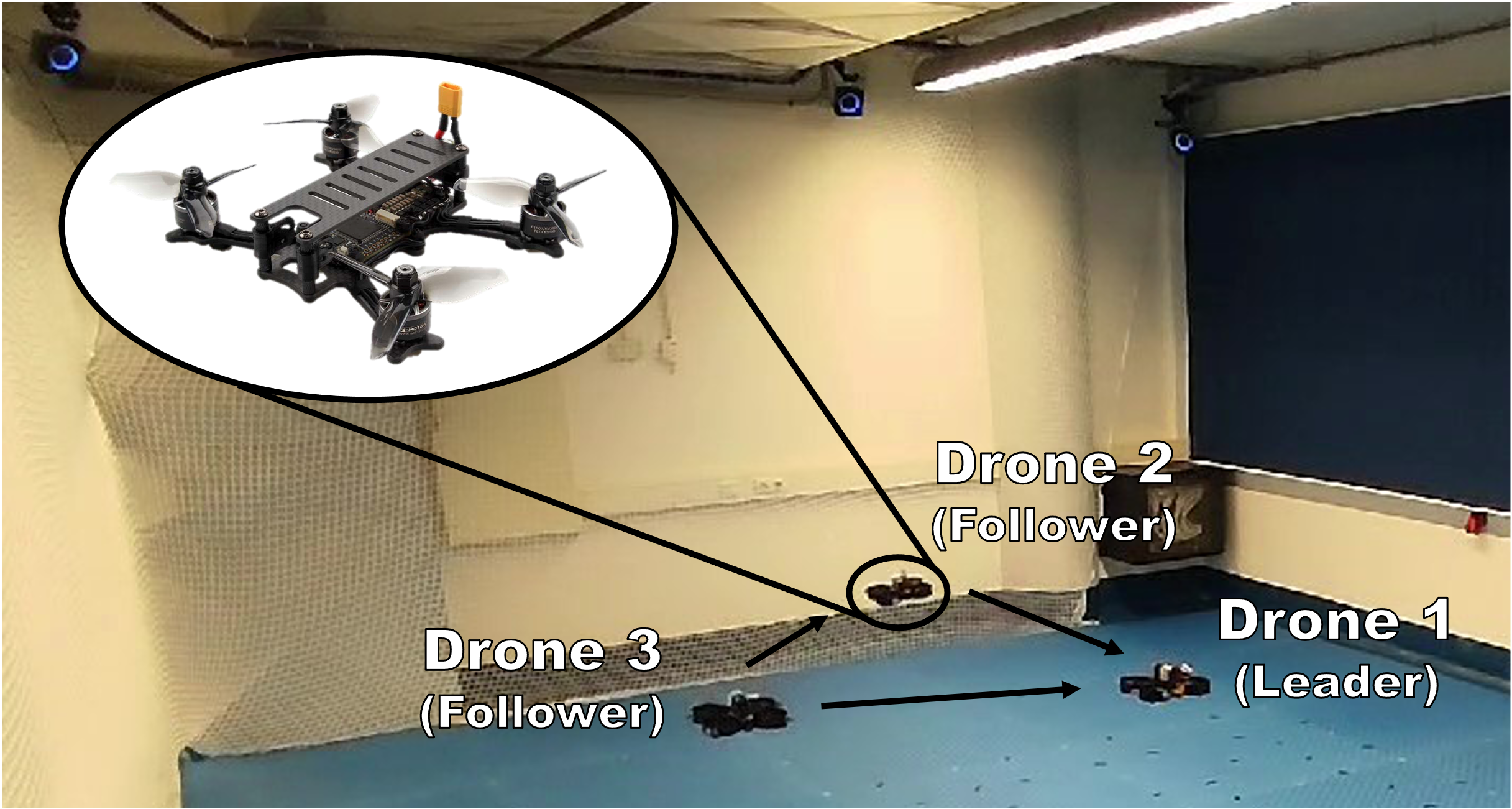
This work addresses the practical problem of distributed formation tracking control of a group of quadrotor vehicles in a relaxed sensing graph topology with a very limited sensor set, where only one leader vehicle can access the global position. Other vehicles in the formation are assumed to only have access to inter-agent bearing (direction) measurements and relative velocities with respect to their neighbor agents. A hierarchical control architecture is adopted for each quadrotor, combining a high-gain attitude inner-loop and an outer-loop bearing-based formation controller with collision avoidance augmentation. The proposed method enables a group of quadrotors to track arbitrary bearing persistently exciting desired formations, including time-varying shapes and rotational maneuvers, such that each quadrotor only requires relative measurements to at least one neighboring quadrotor. The effective performance of the control strategy is validated by numerical simulations in MATLAB and real-world experiments with three quadrotors.
Abstract
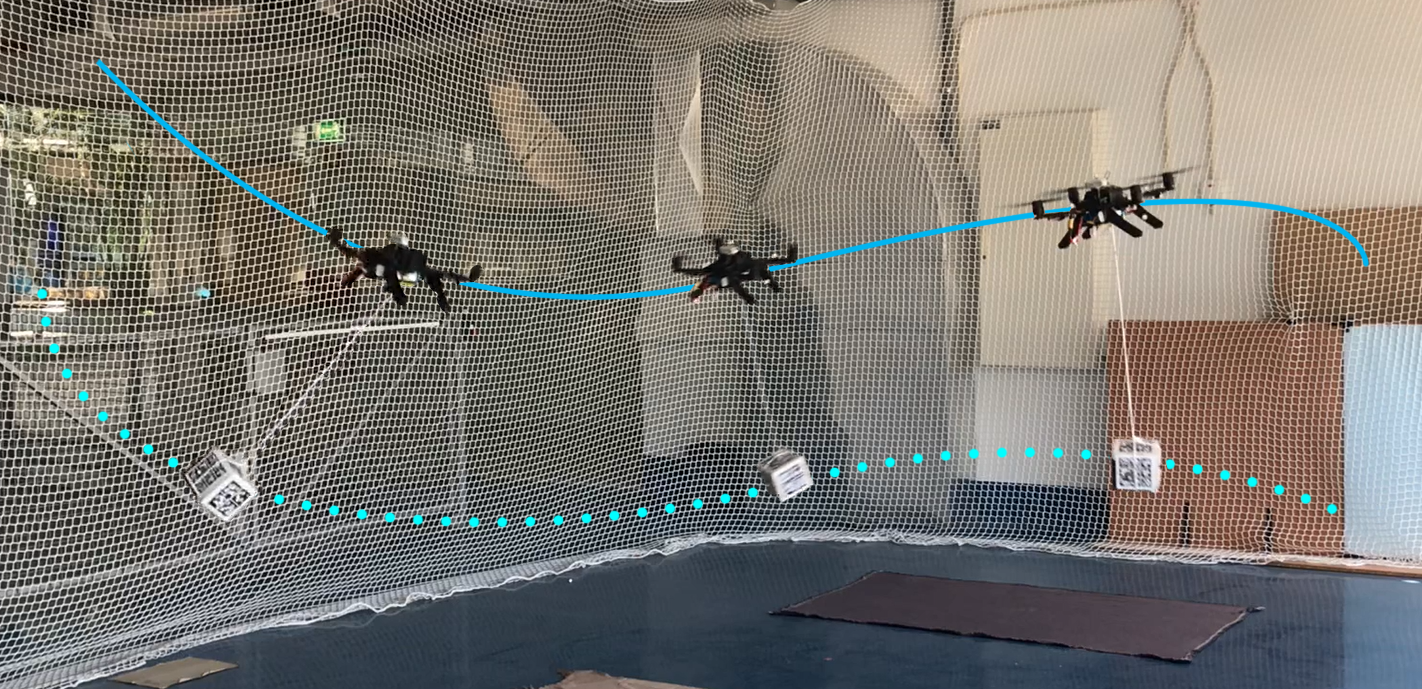
Recent advances in aerial robotics have enabled the use of multirotor vehicles for autonomous payload transportation. Resorting only to classical methods to reliably model a quadrotor carrying a cable-slung load poses significant challenges. On the other hand, purely data-driven learning methods do not comply by design with the problem’s physical constraints, especially in states that are not densely represented in training data. In this work, we explore the use of physics-informed neural networks to learn an end-to-end model of the multirotor-slung-load system and, at a given time, estimate a sequence of the future system states. An LSTM encoder-decoder with an attention mechanism is used to capture the dynamics of the system. To guarantee the cohesiveness between the multiple predicted states of the system, we propose the use of a physics-based term in the loss function, which includes a discretized physical model derived from first principles together with slack variables that allow for a small mismatch between expected and predicted values. To train the model, a dataset using a real-world quadrotor carrying a slung load was curated and is made available. Prediction results are presented and corroborate the feasibility of the approach. The proposed method outperforms both the first principles physical model and a comparable neural network model trained without the physics regularization proposed.
Abstract
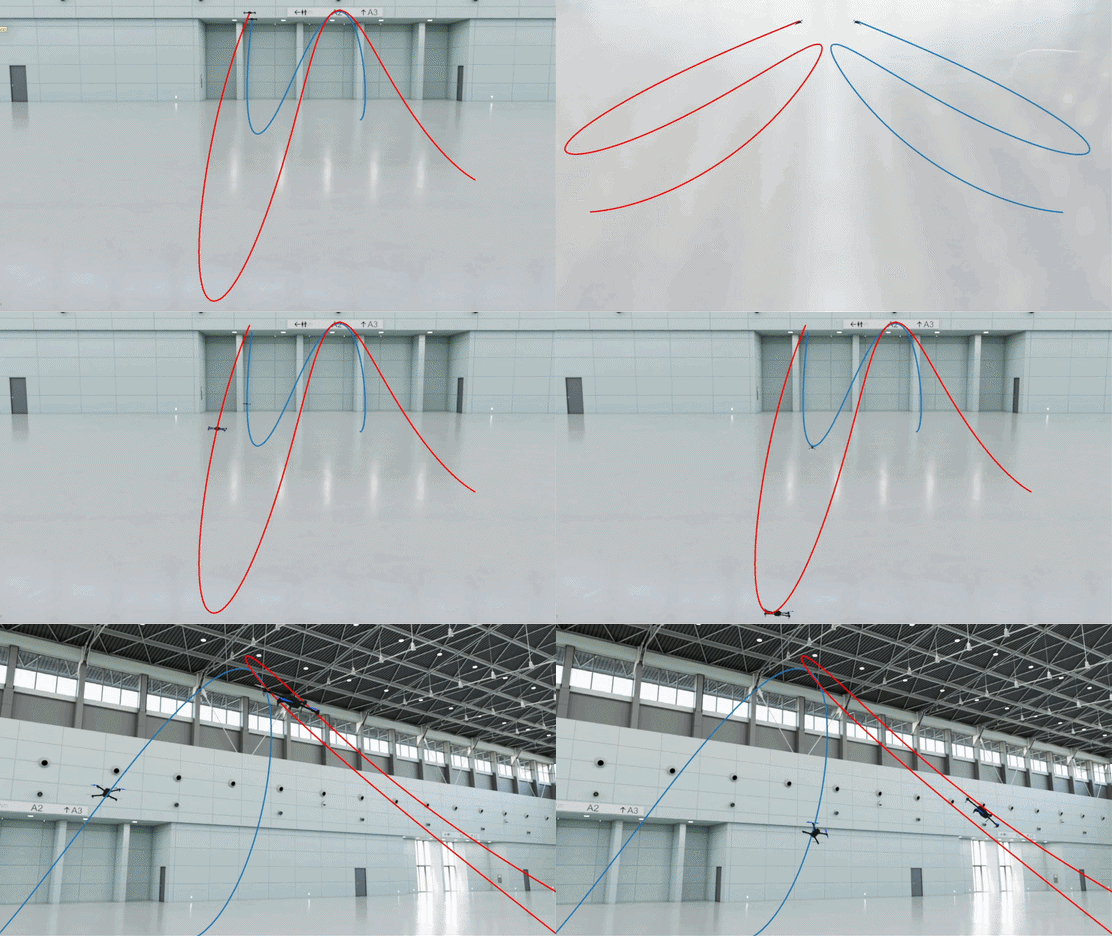
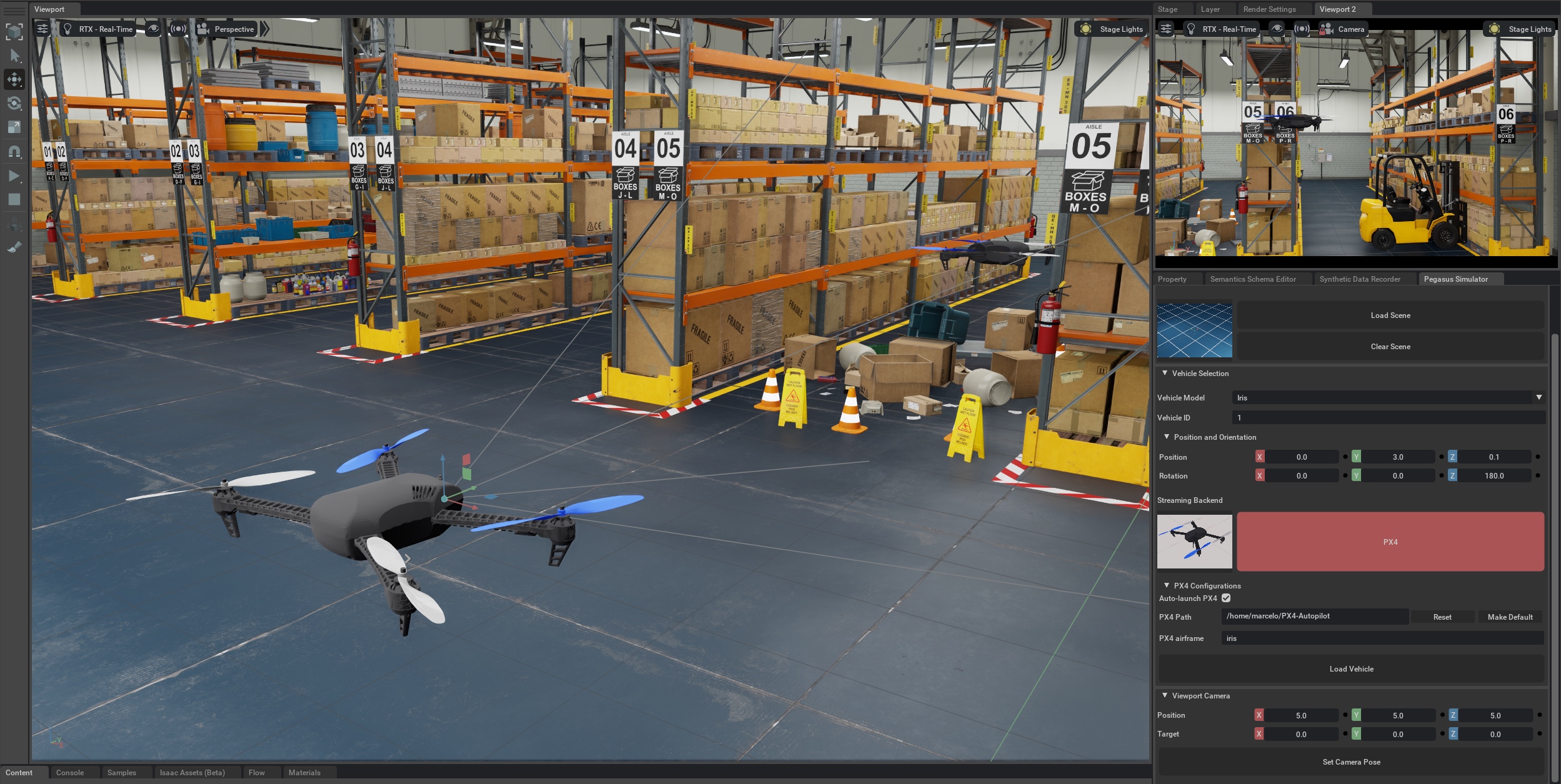
Developing and testing novel control and motion planning algorithms for aerial vehicles can be a challenging task, with the robotics community relying more than ever on 3D simulation technologies to evaluate the performance of new algorithms in a variety of conditions and environments. In this work, we introduce the Pegasus Simulator, a modular framework implemented as an NVIDIA ® Isaac Sim extension that enables real-time simulation of multiple multirotor vehicles in photo-realistic environments, while providing out-of-the-box integration with the widely adopted PX4-Autopilot and ROS2 through its modular implementation and intuitive graphical user interface. To demonstrate some of its capabilities, a nonlinear controller was implemented and simulation results for two drones performing aggressive flight maneuvers are presented. Code and documentation for this framework are also provided as supplementary material.
Abstract
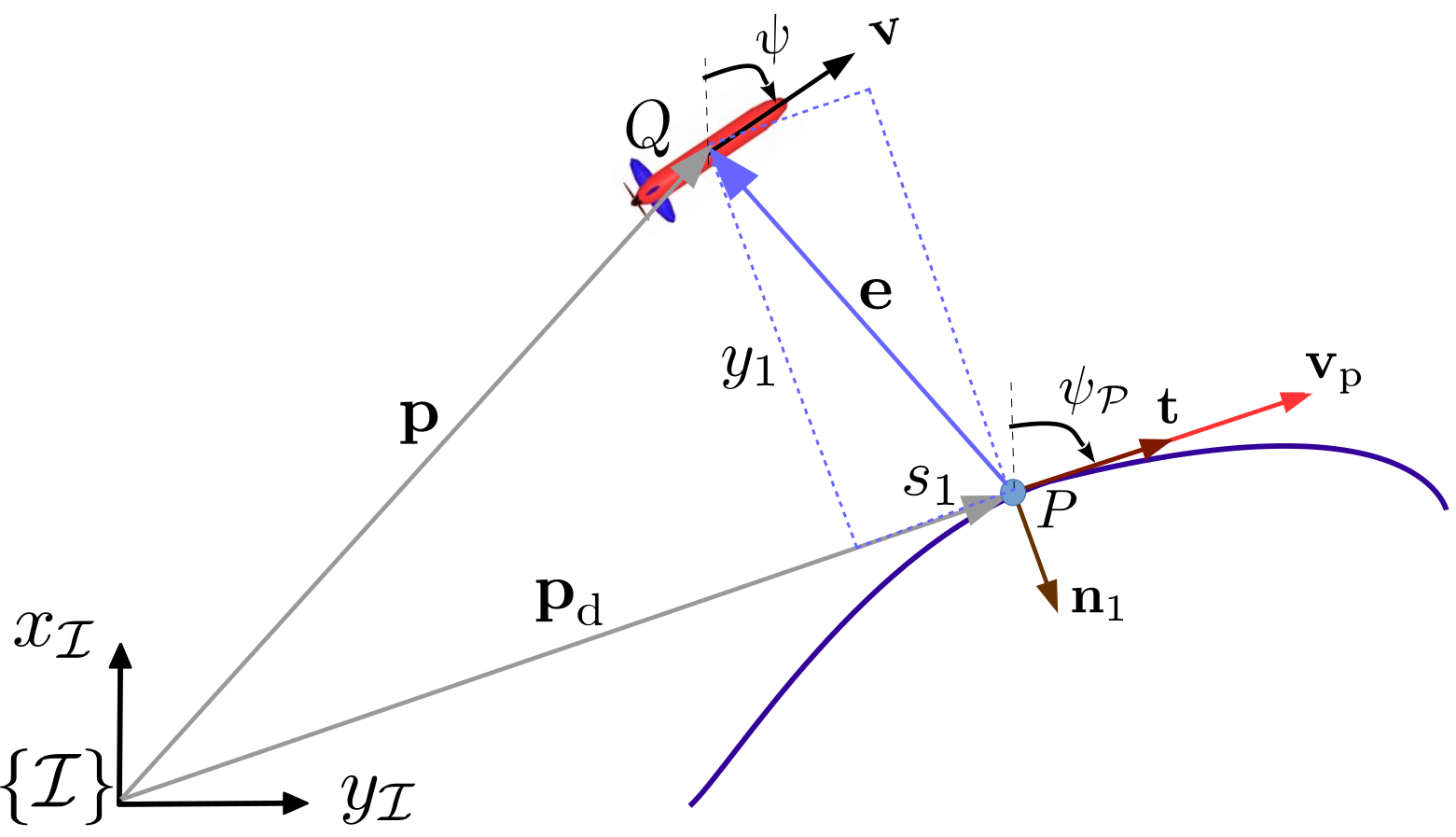
This article presents an in-depth review of path following control strategies that are applicable to a wide range class of marine, ground, and aerial autonomous robotic vehicles. From a control system standpoint, path following can be formulated as the problem of stabilizing a path following error system that describes the dynamics of position and possibly orientation errors of a vehicle with respect to a path, with the errors defined in an appropriate reference frame. In spite of the large variety of path following methods described in the literature we show that, in principle, most of them can be categorized in two groups: stabilization of the path following error system expressed either in the vehicle's body frame or in a frame attached to a “reference point” moving along the path, such as a Frenet-Serret (F-S) frame or a Parallel Transport (P-T) frame. With this observation, we provide a unified formulation that is simple but general enough to cover many methods available in the literature. We then discuss the advantages and disadvantages of each method, comparing them from the design and implementation standpoint. We further show experimental results of the path following methods obtained from field trials testing with under-actuated and over-actuated autonomous marine vehicles. In addition, we introduce open-source Matlab and Gazebo/ROS simulation toolboxes that are helpful in testing path following methods before their integration in the combined guidance, navigation, and control systems of autonomous vehicles.
Abstract
This paper focuses on the description of the Blue-RoSES project, an European funded activity devoted to the development and exploitation of a reliable infrastructure for the remote employment of Remotely Operated Vehicles (ROVs) for both professional and recreational applications in coastal environments, marinas and yachting. The paper firstly provides an overall view of the concept and then summarizes the main modules composing the architecture that is responsible for reliable and stable remote piloting of ROVs. Analysis of the critical issues related to remote piloting and control is carried out and measurements of the communication lags and delays are performed to obtain a statistical characterization, also providing a quantitative measure of the communication service. The reliability and performance of the complete system are demonstrated through experimental campaigns in real case scenarios.
Abstract
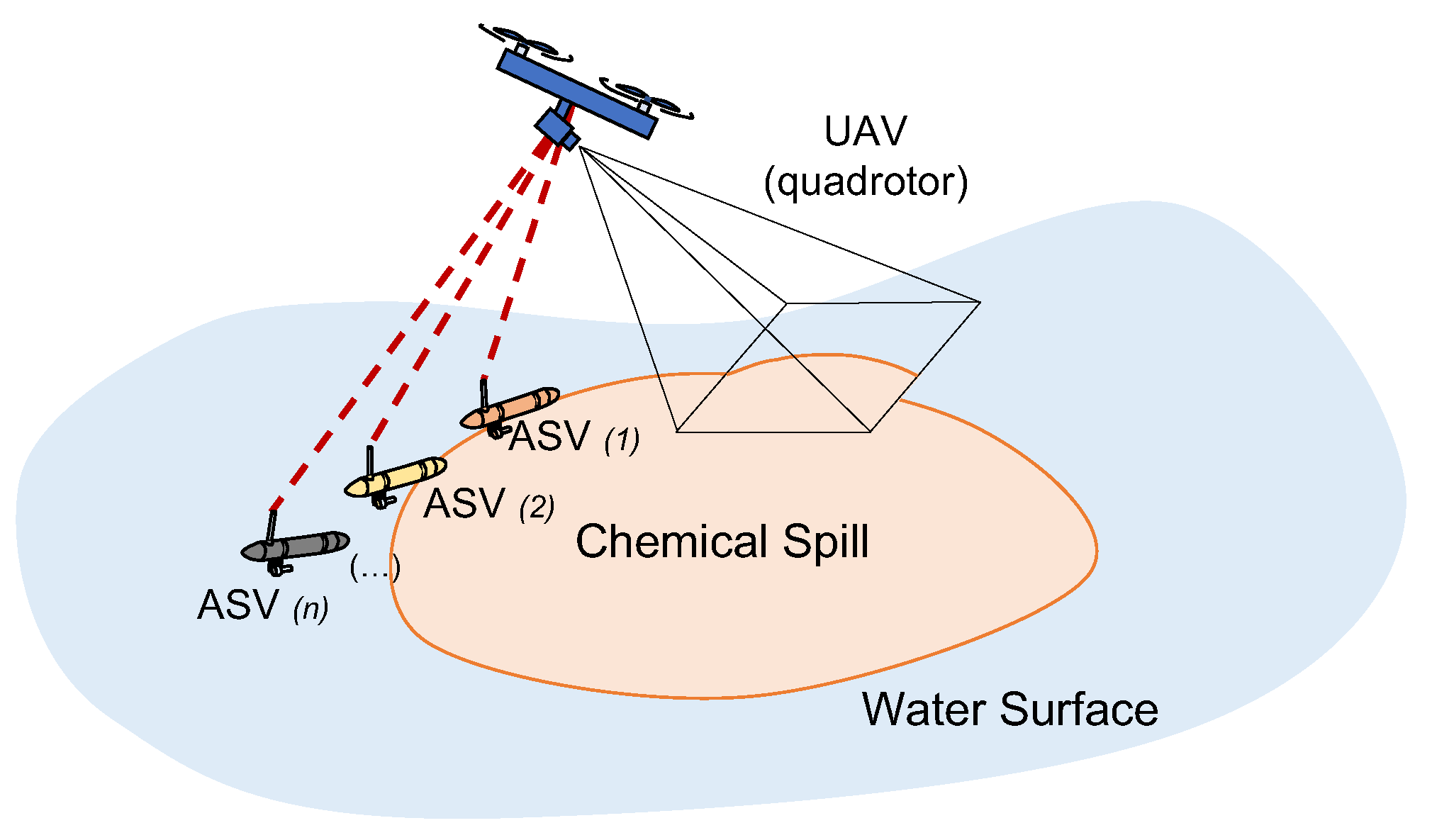
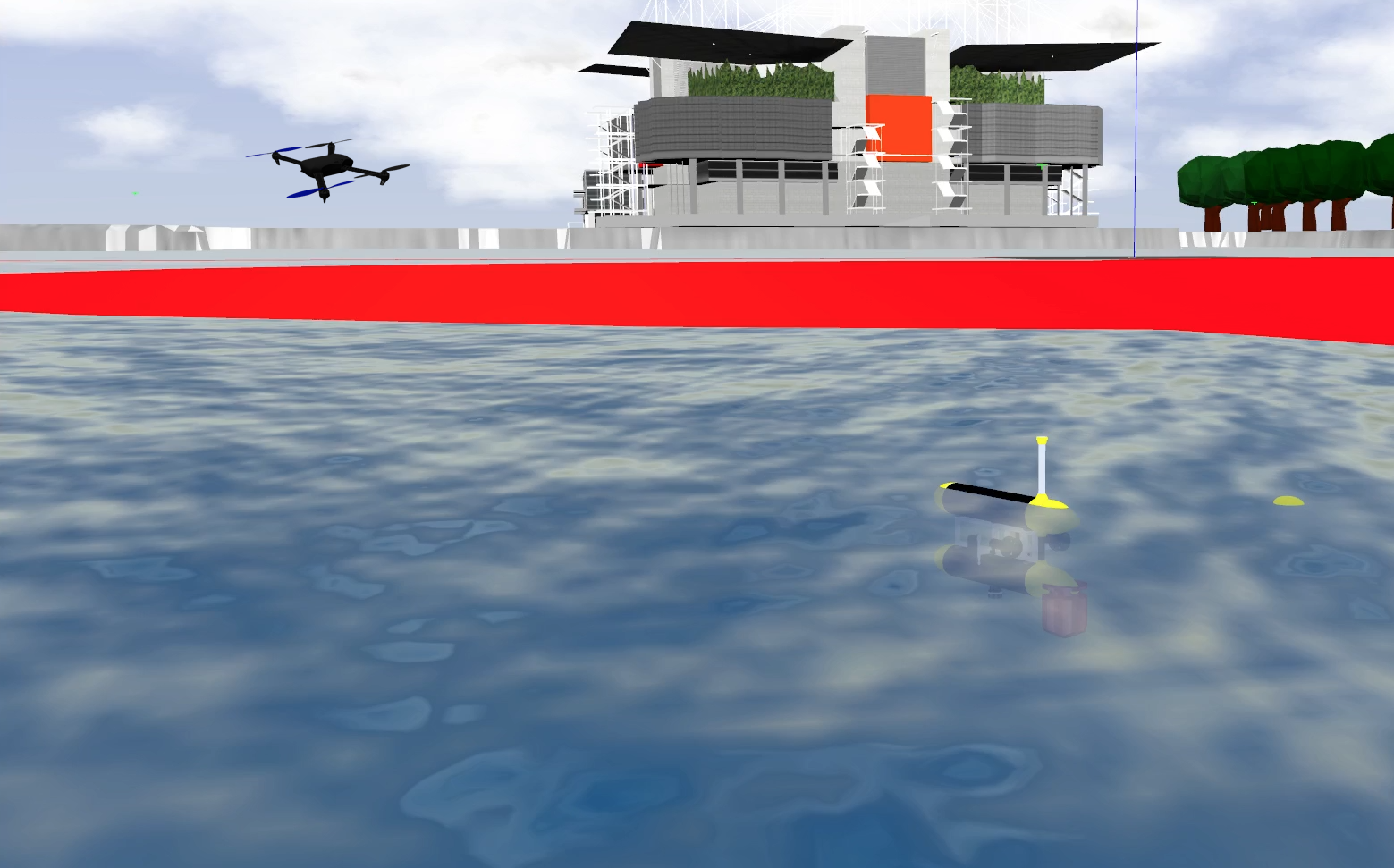
This article addresses the problem of formation control of a quadrotor and one (or more) marine vehicles operating at the surface of the water with the end goal of encircling the boundary of a chemical spill, enabling such vehicles to carry and release chemical dispersants used during ocean cleanup missions to break up oil molecules. Firstly, the mathematical models of the Medusa class of marine robots and quadrotor aircrafts are introduced, followed by the design of single vehicle motion controllers that allow these vehicles to follow a parameterised path individually using Lyapunov-based techniques. At a second stage, a distributed controller using event-triggered communications is introduced, enabling the vehicles to perform cooperative path following missions according to a pre-defined geometric formation. In the next step, a real-time path planning algorithm is developed that makes use of a camera sensor, installed on-board the quadrotor. This sensor enables the detection in the image of which pixels encode parts of a chemical spill boundary and use them to generate and update, in real time, a set of smooth B-spline-based paths for all the vehicles to follow cooperatively. The performance of the complete system is evaluated by resorting to 3-D simulation software, making it possible to visually simulate a chemical spill. Results from real water trials are also provided for parts of the system, where two Medusa vehicles are required to perform a static lawn-mowing path following mission cooperatively at the surface of the water.
Abstract
This paper addresses the problem of underwater navigation of autonomous underwater vehicles via a Monte Carlo estimation approach that relies on the use of a prior digital elevation map of the seabed and bathymteric data acquired with a Multibeam Echosounder. The Monte Carlo estimation procedure is implemented in the form of a particle filter, as part of a multi-sensor fusion framework for underwater geophysical navigation. The contribution of this paper focuses on two main topics: i) development of a particle filter as a solution to a terrain-based Bayesian vehicle positioning problem, followed by filter implementation and simulation and ii) integration of the particle filter structure in a multi-sensor fusion architecture for vehicle navigation with a view to increasing navigation accuracy. The results of realistic simulations with a dedicated marine robotics system simulator illustrate the navigation performance achieved with the proposed solution.
Abstract
This work addresses the problem of formation control of a quadrotor and one (or more) marine vehicles operating at the surface of the water with the end goal of encircling the boundary of a chemical spill. Firstly, the mathematical models of the Medusa class of marine robots, and quadrotor aircrafts are introduced, followed by the design of single vehicle motion controllers that allow these vehicles to follow a parameterized path individually. Inner-outer loop schemes coupled with Lyapunov based techniques are used for control design. At a second stage, a distributed coordination controller using event triggered communications is introduced, enabling the vehicles to perform cooperative path following missions according to a pre-defined geometric formation. In the next step, a real time path planning algorithm is developed that makes use of a camera sensor, installed on-board the quadrotor. This sensor enables the detection in the image of which pixels encode parts of a chemical spill boundary and use them to generate and update in real time a set of smooth B-spline based paths for all the vehicles to follow cooperatively. The performance of the complete system is evaluated by resorting to 3-D simulation software, making it possible to simulate visually a chemical spill. Results from real water trials are also provided for parts of the system, where two Medusa vehicles are required to perform a static lawn-mowing path following mission cooperatively at the surface of the water.